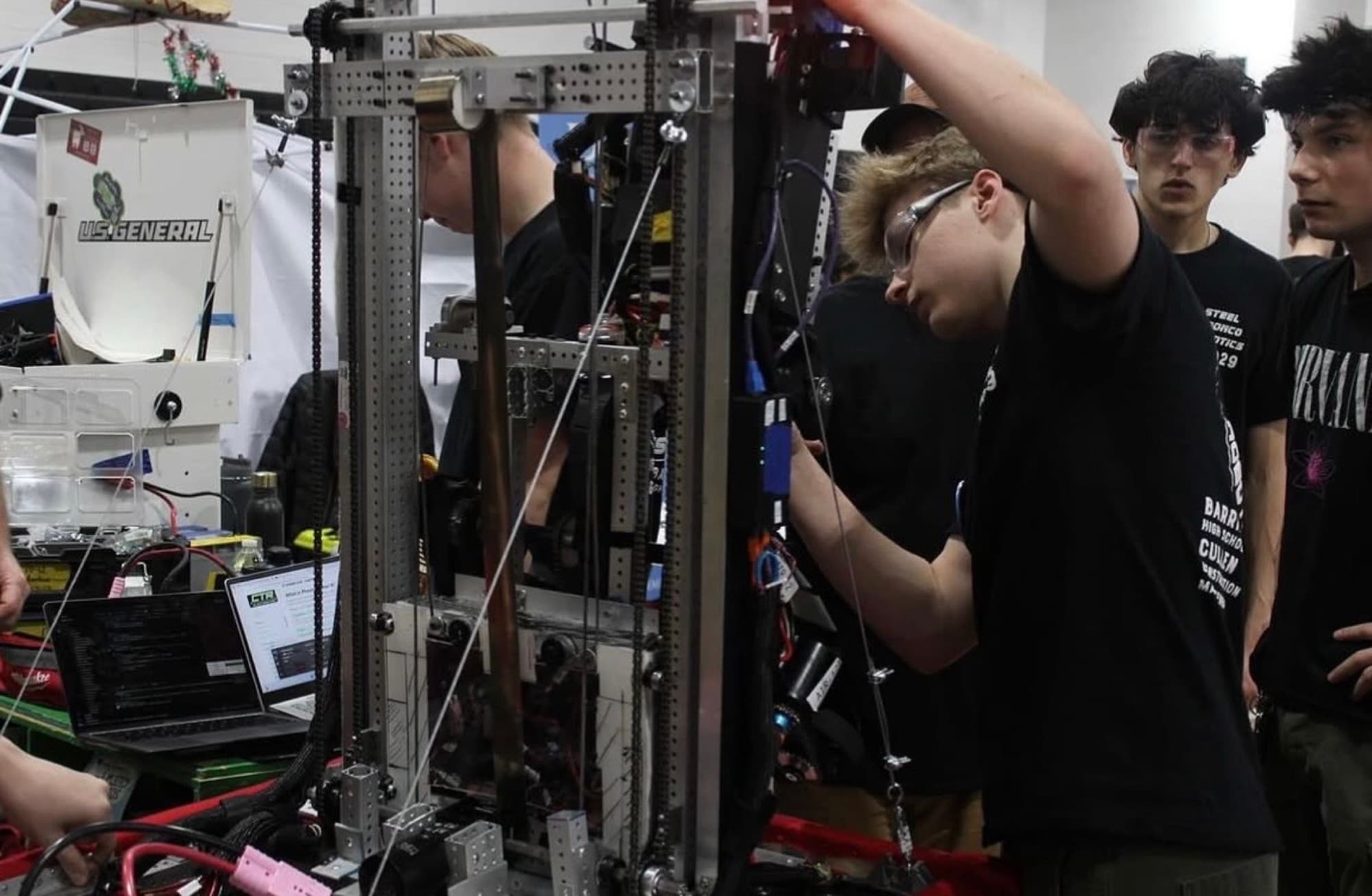
From CAD to competition.
- Team 8029
- Barrington, Illinois
One framework. A new game every year.
Each January, FIRST releases a different game with a new field, scoring system, and set of constraints. We use the same seven-stage framework to turn that unfamiliar challenge into a competition-ready robot.
- 01
Define
Read the game, identify scoring priorities, and set the design requirements the robot has to satisfy.
- 02
Design
Model mechanisms and assemblies in CAD before anything is cut, so problems surface on screen rather than on the field.
- 03
Prototype
Build rough versions fast to test whether a mechanism actually works before committing to it.
- 04
Manufacture
Turn drawings into physical parts — machining, fabrication, and printing.
- 05
Assemble
Bring mechanical, electrical, and software together into one working system.
- 06
Test
Drive it, break it, and fix what breaks. Iterate until it holds up under competition conditions.
- 07
Compete
Run the robot under match pressure, with a drive team and a pit crew working against the clock.
Designed before it’s built.
Before anything is cut or machined, every mechanism is modelled in 3D. Parts, assemblies, and full robots are designed on screen first, so interference, weight, and fit problems surface before a single part exists.
Design work is iterative — a mechanism is rarely right on the first pass. Models are revised against feedback from prototyping and manufacturing until a design is ready to build for real.
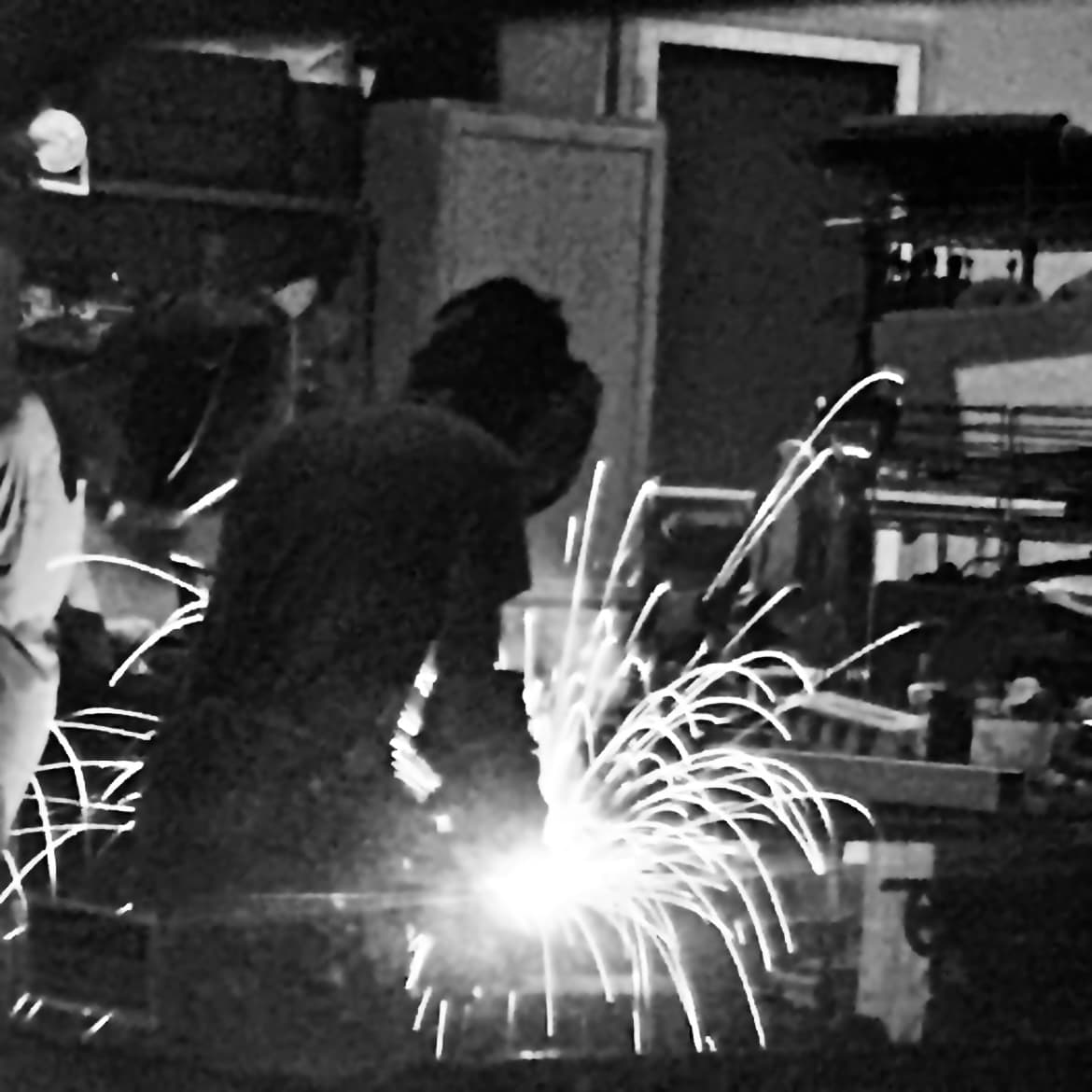
Ideas become hardware.
Once a design is ready, it moves to the shop. Machining and fabrication turn drawings into the physical parts that make up the robot — cut, drilled, and assembled to the tolerances the design calls for.
This is where design assumptions get tested against reality. Parts that looked right on screen sometimes need a second pass once they exist in metal and plastic.
Power, control, and wiring.
The electrical system carries power from the battery to every motor and sensor on the robot, and carries signals back the other way. That means building the wiring harness, mounting and protecting control hardware, and integrating the sensors that give the robot information about itself and its surroundings.
A clean, reliable electrical build matters as much as any mechanism — a robot with a great drivetrain still doesn’t move if a connection fails mid-match.
Code that drives the robot.
Software turns driver input into robot motion, and writes the autonomous routines that run at the start of every match without a driver at the controls. That includes reading inputs from the driver station, coordinating multiple mechanisms so they work together safely, and tuning control logic so the robot responds the way the drive team expects under match pressure.
Vision work adds cameras and sensors so the robot can locate targets and field elements on its own, feeding that information back into both autonomous routines and driver-assisted control. New software members join with existing programming experience in Java.
Engineering under pressure.
Every design decision, every wiring choice, and every line of code is ultimately tested the same way: on the field, in a timed match, with no do-overs.
See our competition record